Digital End Run: Prediction Markets & Erosion of the Texas Gambling Ban
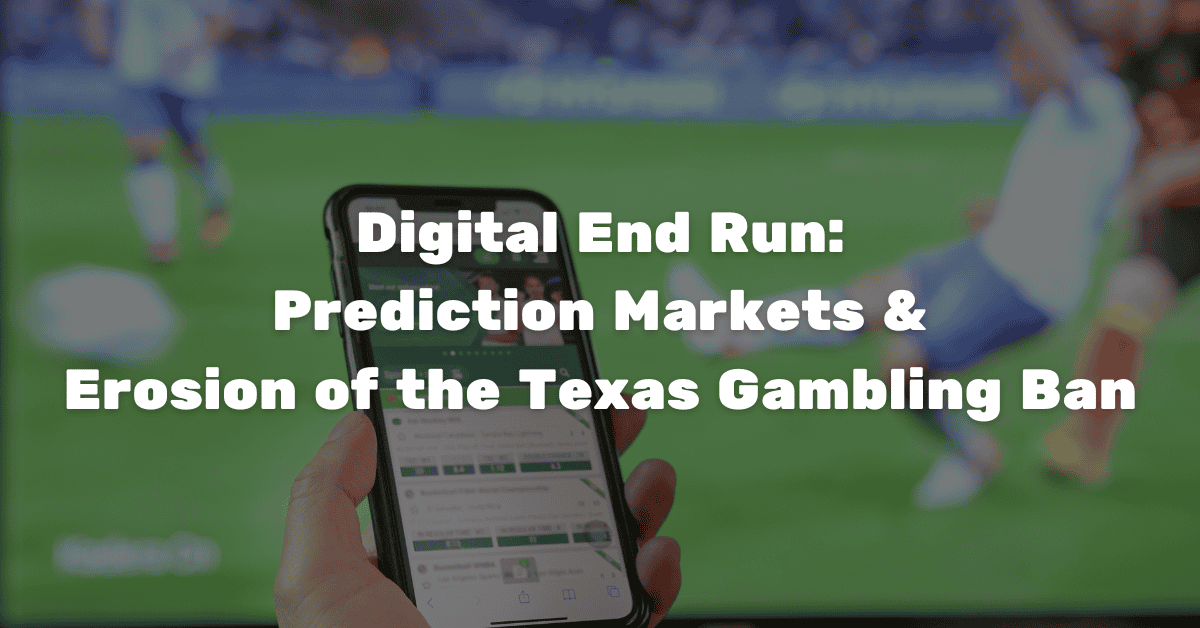
Texans are told gambling is illegal here. But pull out your phone, open the right app, and you can “bet” on the Super Bowl, the Golden Globes, the economy, or even elections—right from your living room.
That’s because a new industry is working hard to convince regulators and the public that this isn’t gambling at all. They call it “prediction markets.” They call it “trading.” But for most users, it looks and feels exactly like wagering—just rebranded as investing.
Under Texas law, gambling is broadly prohibited. Texas Penal Code § 47.02 makes it illegal to “make a bet on the partial or final result of a game or contest.” The statute uses plain language—“bet”—not financial jargon like “derivative” or “event contract.” But prediction market companies like Kalshi and Polymarket argue they fall outside that definition because they are federally regulated financial exchanges overseen by the Commodity Futures Trading Commission (CFTC). Their strongest legal claim is federal preemption: that federal law governing commodities trading overrides state gambling laws.
That sets up the real legal fight—where do we draw the line between a federally regulated financial product and something a state can still call gambling?
The default rule under the federal Commodity Exchange Act gives the CFTC broad authority and jurisdiction over futures, options, and so-called “event contracts.” But that authority is not unlimited. And the CFTC has not clearly approved all forms of prediction markets, particularly those tied to elections. Regulatory policy in this area has been inconsistent at best. See KalshiEX LLC v. Commodity Futures Trading Commission, No. 1:23-cv-03257 (D.D.C. Sept. 12, 2024) And even where federal authority exists, states still retain traditional police powers—especially when it comes to protecting the integrity of elections and preventing harmful conduct within their borders.
That matters, because betting on elections is not just another market innovation—it directly implicates core state sovereignty. Texas has a strong interest in ensuring its elections are not turned into commodities to be traded for profit. Texas also has a strong interest in protecting its youth. Unlike traditional gambling, these platforms are available 24/7 on a smartphone, accelerating addictive behavior and exposing younger users to financial risk at an earlier age—often under the misleading label of “investing.”
Meanwhile, these platforms are not quietly operating in the background. Prediction market advertising is already reaching Texans—through online ads, social media, and even physical billboards. Companies are actively promoting these platforms in states like Texas, where traditional sports betting remains illegal. That should raise serious concerns for Texas policymakers. Even if there is a legal debate about the underlying activity, the argument for federal preemption is far weaker when it comes to advertising. States have long had the authority to regulate deceptive, harmful, or targeted advertising—especially when it reaches minors or promotes conduct that would otherwise violate state policy.
Texas lawmakers should not ignore this growing loophole. The issue is already on the Legislature’s radar—Lt. Governor Dan Patrick issued an interim charge last month directing the Texas Senate Committee on State Affairs to examine how prediction markets may be exploiting federal law to bypass Texas gambling prohibitions. At a minimum, the state should clarify that prediction markets fall within existing gambling prohibitions when they function as wagers. Lawmakers should also consider restricting or prohibiting advertising of these platforms within Texas, requiring robust age verification, and ensuring that companies cannot exploit legal gray areas to bypass protections Texans expect.
This is not just about keeping up with technology. It’s about whether long-standing Texas law can be quietly undermined by a digital workaround. Gambling by another name is still gambling. And Texans shouldn’t have to pretend otherwise just because Washington calls it something different.